
Water-Based Emulsions for Coatings: Choosing the Right Binder for Performance and Sustainability
What makes a good coating? Ask a formulator and you’ll get a different answer depending on the application — a facade paint needs to withstand years of weathering, a furniture lacquer needs a flawless finish, an industrial coating needs to perform under stress. But behind almost every answer today, one requirement is constant: it has to be water-based.
The shift toward water-based polymer dispersions has transformed the coatings industry over the past decades, and it shows no sign of slowing down. Regulatory pressure on VOC emissions, growing demand for safer working environments, and end-customers who increasingly expect sustainable products have made water-based technology the default starting point for formulators — not an alternative to consider.
The challenge is that “water-based” is not one solution. Choosing the right binder — and understanding the trade-offs involved — is what separates a coating that merely complies from one that truly performs.
The building blocks: types of polymer dispersions for coatings
Most coatings formulated today rely on one of three families of water-based emulsions, each with a distinct performance profile:
Acrylics offer excellent UV and weathering resistance, making them a strong choice for exterior applications where color retention and durability over time matter most — facades, exterior wood, and long-life industrial coatings.
Styrene-acrylics bring a strong balance between cost-efficiency and performance, with good mechanical properties and water resistance. They are widely used in interior wall paints and general-purpose coatings where budget and performance need to meet in the middle.
Vinyl acetate (VeoVa) copolymers are valued for their flexibility, adhesion, and workability, and are a common choice in DIY and decorative paints where ease of application is a priority for the end user.
None of these is universally “better” — the right choice depends entirely on the application, the substrate, and the performance properties that matter most for that specific formulation.
The properties that really decide a formulation
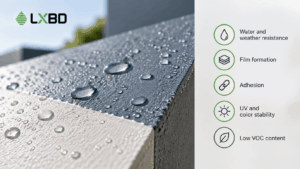
Beyond the binder family, a handful of properties tend to define whether a coating will succeed in the field:
- Water and weather resistance — how the film behaves under rain, humidity, and temperature cycles over its service life.
- Film formation — the ability of the dispersion to form a continuous, defect-free film at the application temperature, which directly affects both appearance and protection.
- Adhesion — how well the coating bonds to the substrate, especially critical on demanding surfaces like masonry, metal, or previously coated systems.
- UV and color stability — particularly relevant for exterior and light-colored coatings, where chalking or yellowing quickly become visible defects.
- VOC content — no longer a differentiator but a baseline requirement, shaped by increasingly strict European regulations.
Getting one of these right rarely means getting them all right — which is exactly why binder selection is a formulation decision, not a checklist.
Sustainability is the standard, not the extra
A few years ago, “low VOC” was enough to position a coating as sustainable. That bar has moved. Today, sustainability in coatings means looking at the full picture: raw material sourcing, energy efficiency in production, and the long-term durability of the finished product — a coating that needs reapplying every few years is rarely the more sustainable option, however low its VOC content.
This is a topic we explored in more depth in our article — the short version is that sustainability now needs to be engineered into the formulation from the start, not added as an afterthought.
How LXBD supports formulators, from lab to application
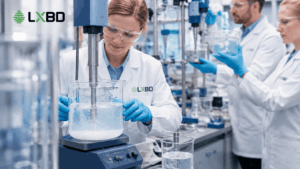
At LXBD, our water-based emulsions for coatings: acrylic, styrene-acrylic, and vinyl acetate VeoVa dispersions are developed to meet the technical and regulatory demands of the European market, across both DIY and industrial coatings. But a good binder is only part of the equation — what makes the difference is the support behind it.
Our formulations go through our own R&D and quality laboratories before reaching production, and our technical team works closely with formulators to fine-tune performance for their specific application — from initial trials to full-scale production. It’s this combination of technical expertise and hands-on manufacturing know-how that allows us to support customers reliably, from formulation to final application.
Looking for the right binder for your next formulation?
Whether you’re formulating an exterior facade paint, an interior wall coating, or a DIY decorative product, choosing the right water-based dispersion starts with understanding what your application really needs.
👉 Explore LXBD’s coating solutions: Portfolio .
👉 Get in touch with our technical team: Contact.