

Low VOC Coatings Are No Longer Enough: The Future of Sustainable Dispersions
Sustainable performance is redefining formulation strategies across the coatings industry
For years, reducing VOC content was considered one of the main indicators of sustainability in the coatings industry. Regulatory pressure and environmental awareness accelerated the transition from solvent-based to water-based technologies, transforming formulation standards across Europe.
Today, however, the conversation has evolved.
Low VOC is no longer enough.
The new challenge facing formulators is far more complex: developing water-based systems capable of reducing environmental impact while maintaining — or even improving — technical performance, durability and formulation efficiency.
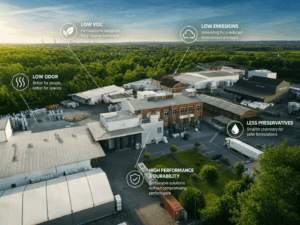
– Lower odor.
– Lower emissions.
– Fewer preservatives.
– Greater durability.
All at the same time.
This shift is redefining how coatings are formulated, manufactured and evaluated across the European market.
At LXBD, we see a clear transformation in the industry. Companies are no longer searching only for compliance-driven solutions. They are looking for smarter systems capable of simplifying formulations, improving efficiency and supporting long-term sustainability goals without compromising performance.
Because sustainable coatings are not simply about removing components.
They are about engineering balance.
From Regulatory Compliance to Performance Sustainability
The first wave of sustainable coatings innovation was heavily focused on VOC reduction. European regulations accelerated the adoption of water-based technologies, pushing manufacturers to replace traditional solvent-based systems with lower-emission alternatives.
That transition fundamentally changed the industry.
However, as water-based technologies matured, new expectations emerged from both regulators and the market itself.
Today’s coatings must not only meet environmental requirements, but also respond to increasing demands related to:
- Indoor air quality
- Low odor application
- Reduced emissions during drying
- Lower preservative content
- Improved user safety
- Greater durability and resistance
- Higher efficiency in manufacturing processes
In many sectors — especially architectural, industrial and decorative coatings — sustainability is now evaluated through a broader lens. Performance throughout the product lifecycle has become just as important as the reduction of individual components.
As a result, formulation strategies are becoming significantly more sophisticated.
The Complexity Behind Cleaner Formulations
Reducing VOCs or preservatives may sound straightforward in theory, but in practice it introduces major technical challenges.
Water-based systems are highly sensitive environments. Every modification within the formulation can affect stability, compatibility, rheology, application properties or long-term durability.
For formulators, achieving the right balance often means navigating competing requirements simultaneously.
Lower preservative content, for example, increases the complexity of microbiological protection. Reduced coalescent levels may affect film formation and mechanical resistance. Low odor targets can limit the selection of raw materials traditionally used to optimize performance.
At the same time, end users still expect coatings to deliver excellent:
- Adhesion
- Scrub resistance
- Chemical resistance
- Exterior durability
- Color stability
- Application properties
This is precisely where modern formulation expertise becomes critical.
Sustainable performance can no longer rely on isolated substitutions or incremental changes. It requires a systemic approach where raw materials, additive technologies and formulation architecture work together as an integrated system.
The Growing Focus on Preservative Reduction
One of the most important formulation trends currently shaping the European coatings market is the reduction of preservatives and biocides.
Driven by evolving regulations, increased market sensitivity and growing consumer awareness, many manufacturers are actively seeking solutions that minimize preservative content while maintaining product safety and shelf stability.
Yet preserving water-based systems remains technically demanding.
Lower preservative formulations require:
- More efficient raw material selection
- Improved formulation robustness
- Better process control
- Enhanced system compatibility
- Greater microbiological balance
This challenge is pushing the industry toward multifunctional technologies capable of delivering several performance benefits simultaneously.
The objective is no longer simply replacing one ingredient with another. Instead, formulators are increasingly focused on creating optimized systems that reduce formulation complexity while maintaining reliability and consistency.
Smarter Systems for the Next Generation of Coatings
As sustainability expectations continue to evolve, efficiency is becoming a key pillar of innovation.
This includes not only environmental efficiency, but also formulation efficiency.
Across the coatings industry, there is a growing interest in:
- Multifunctional additives
- Simplified formulations
- Reduced raw material inventories
- Optimized production processes
- Lower energy consumption
- Improved lifecycle performance
These smarter systems help manufacturers reduce operational complexity while supporting broader sustainability goals.
In many cases, simplifying a formulation can also improve consistency, scalability and overall production reliability.
This is one of the most important shifts currently taking place in the market: sustainability is no longer treated as an isolated environmental objective. It is becoming part of a wider strategy focused on long-term performance, process optimization and intelligent formulation design.
Engineering Balance
The future of sustainable coatings will not be defined solely by lower VOC numbers.
It will be defined by the industry’s ability to engineer balanced systems capable of combining environmental responsibility with high technical performance.
That means developing formulations that:
- Reduce emissions
- Lower odor
- Minimize preservatives
- Improve durability
- Simplify processes
- Maintain application quality
All within increasingly demanding regulatory and commercial environments.
At LXBD, we believe the next generation of water-based coatings will be driven by smarter formulation strategies designed to deliver sustainability through balance, not compromise.
Because the coatings industry is no longer asking how to remove components.
It is asking how to build better systems.